
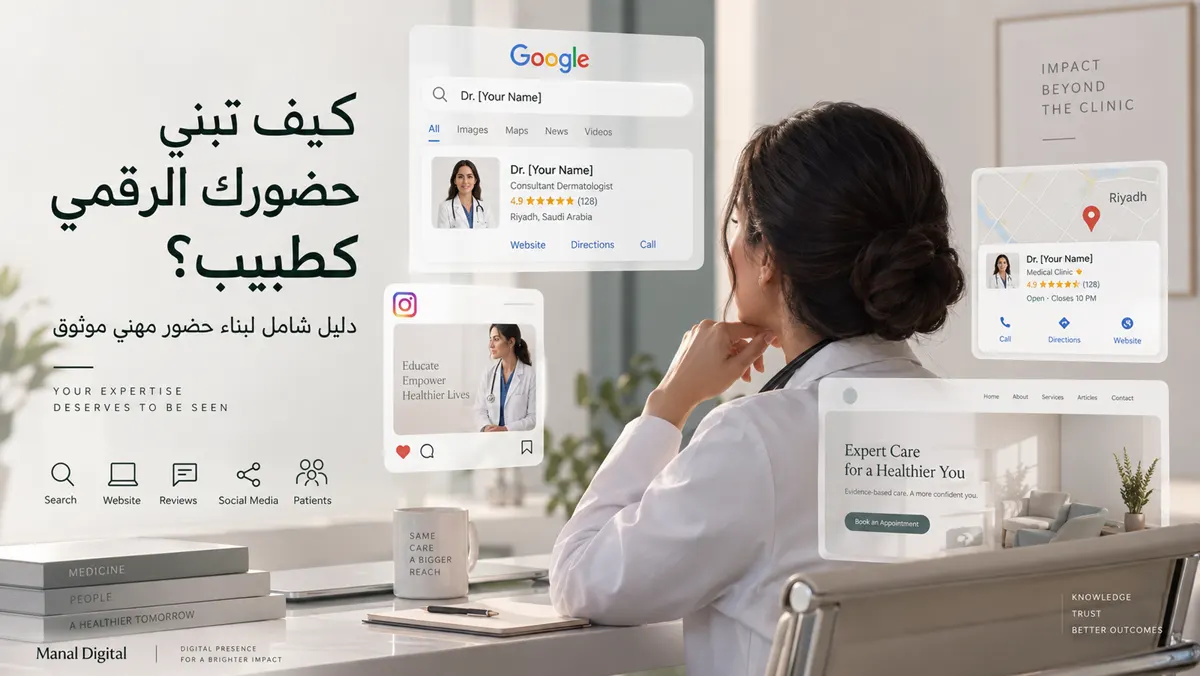
Today, the patient journey does not always start at the clinic door, or even with a personal recommendation. In many cases, it starts on a phone screen.
A patient may hear a doctor’s name from a friend, see them in a social media clip, or search directly for a doctor in a given specialty. Then verification begins: they search the doctor’s name on Google, read reviews, visit the website, watch content, and learn about expertise and specialty before deciding to reach out or book.
That is why a doctor’s digital presence has become an important part of their professional image — not just an extra marketing activity.
Building a strong digital presence does not mean opening an Instagram account and posting constantly. Real presence is a set of connected points that work together so the doctor is clear, trusted, and easy to reach when a patient looks for them.
What does a doctor’s digital presence mean?
A doctor’s digital presence is the image, information, and impression someone finds about the doctor online.
It includes, for example:
- Search results for the doctor’s name on Google.
- A personal website.
- Google Business Profile and Google Maps when available.
- Patient reviews and experiences published online.
- Professional social media accounts.
- Articles and medical content published under the doctor’s name.
- Professional information on other sites and platforms.
In simpler terms: digital presence is the answer a patient gets when they search for the doctor online.
The most important question is not only: Are you online?
It is: What does the patient find when they search for you?
Why has digital presence become important for doctors?
Working in a well-known hospital or clinic does not automatically mean a doctor has an independent digital presence.
A doctor may have long experience and a strong professional record, yet a search for their name turns up little, scattered, or unclear information.
That is where building a professional digital presence matters — so the doctor is presented in a way that reflects real expertise.
A strong digital presence can help with:
How do you start building your digital presence as a doctor?
Building digital presence does not start with posting.
It starts with understanding the picture that already exists.
Before designing a new website or producing dozens of clips, it matters to know what already appears when someone searches the doctor’s name, whether the information is accurate and consistent, and whether a patient can understand the specialty and reach the doctor easily.
After that, presence can be built around a set of core pillars.
1. Clear professional identity
One of the most important elements of building a doctor’s digital presence is a clear professional identity.
Someone should quickly understand three things:
Who is the doctor?
What is their specialty?
What area do they stand out in?
The problem is that some medical accounts and websites hold a lot of information without answering those questions clearly.
The goal is not to compress expertise into a marketing line, but to organize how that expertise is presented so a clear, consistent professional picture forms.
2. A clear presence in Google search
Search your name on Google as if you were a patient hearing about you for the first time.
What do you see?
Is your professional information clear?
Are the results actually about you?
Is your specialty obvious?
Is contact information up to date?
Do old results or pages appear that do not represent you well?
This simple exercise reveals a lot about the strength of a doctor’s digital presence.
Long term, search results should reflect the doctor’s identity, expertise, and field as clearly as possible.
To understand how a patient actually reads search results, see our guide on how patients search for doctors on Google.
3. A website that represents the doctor
Social media matters, but it is not a full substitute for a website.
A social account lives on a platform owned by someone else, while a website gives the doctor an organized space to present professional information in more depth.
A good doctor website should help visitors understand:
- Who the doctor is.
- Specialty and experience.
- Areas and services offered.
- Locations or organizations where they practice.
- Content and medical information related to their specialty.
- How to contact or book.
The website is also an important base for long-term search visibility.
4. Website SEO for search engines
Owning a website does not automatically mean patients will find it.
That is where SEO for doctors — optimizing the site for search engines — comes in.
The goal of SEO is to help search engines understand the site’s content, the doctor’s identity, specialty, and topics tied to their expertise.
Medical SEO should not turn into keyword stuffing.
Good content is written for people first, then organized so search engines can understand it.
Doctor pages and articles should therefore be useful, clear, accurate, and well structured.
5. Digital reputation and reviews
When a patient searches for a doctor, reviews may be among the first things they notice.
So a doctor’s digital reputation is inseparable from digital presence.
Real reviews and patient experiences, plus professional handling of feedback, help form a fuller picture of working with the doctor or facility.
Reputation management does not mean chasing a flawless image with no criticism.
What matters is a steady professional presence that reflects service and communication quality while protecting patient privacy when public reviews are handled.
6. Using social media to build knowledge and trust
Instagram, TikTok, and similar platforms are powerful tools, but their value for a doctor is not measured by follower count alone.
A doctor may have thousands of followers without a clear specialty or a clear reason for a patient to follow them.
Effective medical content helps answer questions patients already have.
For example:
When does a patient need a certain procedure?
Who is a good candidate?
What should they expect before and after?
What is the difference between options?
When should they see the doctor?
That way content shifts from chasing views to building knowledge and trust around the doctor’s name.
7. Medical content as a long-term digital asset
Content should not live only for 24 hours in a Story or a few days on Instagram.
Questions the doctor answers today can become structured content that stays discoverable later.
Articles, website pages, and educational material can build a knowledge library tied to the doctor’s name and specialty.
Over time, the doctor’s online presence becomes deeper than a set of social accounts — they hold a digital knowledge asset that reflects their expertise.
8. Connecting digital presence to the patient journey
Digital presence does not end when the doctor appears on Google or someone watches a clip.
A patient may pass through several points before booking:
Search → learn about the doctor → verify expertise → read reviews → explore content → contact → book.
If one of those points is unclear, the journey may stop.
For example, a patient may see excellent content but not know where to book.
Or find the doctor on Google without enough information.
Or enter the website without a clear way to get in touch.
That is why digital presence should be treated as a connected system, not separate platforms.
9. Keeping information consistent
A common problem is conflicting information about the doctor in different places.
A name written differently, an outdated specialty, an old phone number, a changed clinic location, or inactive accounts that still show up in search.
These details look small, but they affect anyone trying to verify the doctor’s information.
Professional digital presence needs consistency and continuity — not launching a site or accounts and leaving them unupdated.
10. Preparing for AI-powered search
How people search for information is changing.
Alongside Google, users ask AI tools about doctors, specialties, procedures, and health information.
That makes clear, trustworthy, organized information about the doctor even more important.
The website, content, professional pages, reviews, and sources that mention the doctor together form their digital footprint.
Investing in an organized digital presence today does not only serve traditional search — it also prepares for the future of digital discovery.
Does a large following mean a strong digital presence?
No.
A doctor can have a large following while Google visibility is weak, there is no website, reviews are few, and information is scattered.
Conversely, a doctor with a smaller audience may have a stronger, more organized digital presence.
So digital presence success should not be measured by followers alone.
The better question is:
Can a patient find you, understand your specialty, verify your expertise, trust your presence, and reach you easily?
If the answer is yes, you are building digital presence with real value.
A doctor’s digital presence is not a short campaign
Building digital presence does not happen in a week, and it does not end when a website launches or an Instagram account is improved.
It is an ongoing process that grows with the doctor’s expertise, content, reviews, and search visibility.
The end goal is not to be on every platform.
The goal is that the picture of the doctor online is clear, trusted, and consistent with their real professional standing.
When Google, the website, content, reviews, social channels, and contact paths work as one system, digital presence shifts from scattered accounts into a long-term professional asset.
Building a digital presence that reflects real expertise
A doctor may spend years building professional expertise, but the internet does not display that expertise automatically.
There needs to be a clear digital structure that helps patients and search engines understand who the doctor is, their field of expertise, and where accurate information can be found.
At PRESLUME we focus on building doctors’ digital presence as a connected system — starting from professional identity and extending to the website, search visibility, content, and digital reputation — to build presence that reflects the doctor’s value over the long term.
Good digital presence does not create a doctor’s expertise; it makes that expertise easier to discover and understand.
Frequently asked questions about a doctor’s digital presence
Does every doctor need a website?
Not every doctor needs a complex website, but an independent digital space with reliable, organized information can matter — especially for a doctor who wants to build their professional name independently.
Is Instagram enough to build a doctor’s presence?
Instagram is an important channel for content and communication, but it is only one part of digital presence. Google search, the website, reviews, and professional information each play different roles.
How long does it take to build a doctor’s digital presence?
There is no fixed timeline. Core assets can start taking shape relatively quickly, while reputation, organic visibility, and the strength of the doctor’s name in search need ongoing work over the long term.
What is the difference between digital presence and marketing for doctors?
Marketing often focuses on reach and attracting attention or demand, while digital presence is broader: the full picture of the doctor online — from search results and the website to content, reviews, and reputation.
Where should a doctor start?
The best start is understanding the current digital situation: what appears under their name, how clear the specialty is, whether information is accurate, whether a suitable website exists, reviews, accounts, and content tied to their name. Priorities can be set after that.
Related articles
How Do Patients Search for Doctors on Google? And What Makes You Show Up Clearly
From the first word a patient types in Google to the moment they choose a doctor — understand how patients read search results and what makes your name appear clearly when they look for you.
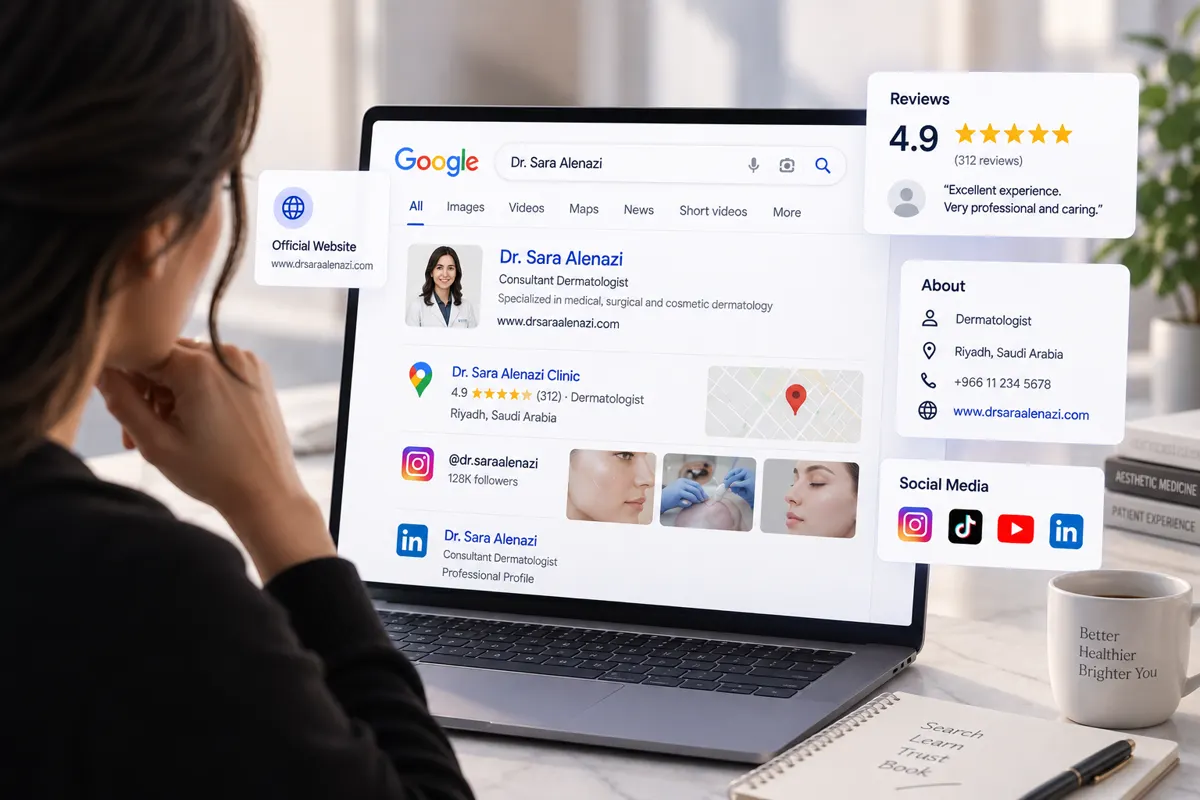
What Does a Patient Find When They Search Your Name on Google?
Before booking, a patient types the doctor’s name on Google. What do they see? How does the professional picture form from results, website, reviews, and social media?