

When a patient decides to look for a doctor, a journey begins that the doctor may not see in detail.
The patient does not search randomly. They usually start with a specific word or question in Google, then move between results, read titles and snippets, compare options, and stop at the result that looks clearest and most trustworthy.
In this short journey, the patient forms quick impressions about every doctor who appears.
That is why appearing in Google does not only mean your name exists in the results. It means your name appears the right way, in the right place, with information that lets the patient continue the journey toward you instead of stopping at someone else.
In this article we walk through how patients actually search for doctors on Google, how they read the results, and what you can do to show up clearly when a patient looks for you.
How does a patient start searching for a doctor?
A patient rarely starts searching from nowhere. There is usually a trigger: new symptoms, a recommendation from someone, a need for a second opinion, or a move to a new city.
Then they open Google and start typing.
What they type first shapes the kind of results they get.
To understand how you appear to patients, it helps first to understand the different patterns of searching for doctors.
What does a patient type in Google?
Searches for doctors usually fall into three main patterns, each with different results and a different way of being read.
How does a patient read search results?
The patient does not read every result. They scan quickly.
In a few seconds they look at:
- The result title: does it seem related to what they need?
- The snippet under the title: does it give a quick answer?
- The doctor or clinic name: does it look trustworthy?
- Reviews if present: what do other patients say?
- Location: is it close and convenient?
Based on these quick impressions, the patient decides which result to click.
That is why the first thing a patient sees about you in Google shapes much of what follows.
Why do the first results matter most?
Most patients do not go past the first page of Google results.
The further down the patient goes, the less likely they are to click a result, and the less they trust it.
So the goal is not only to appear in Google, but to appear in the positions the patient actually looks at.
This does not happen overnight. It needs a clear digital structure: an optimized website, content tied to your specialty, and consistent information about you across more than one source.
What is the difference between regular Google results and Google Maps?
When a patient searches for a doctor in a specific area, two kinds of results appear on the same page:
Map results: a group of clinics and doctors shown with a map location, reviews, and an address.
Regular search results: pages and sites related to the search, ordered by relevance to the search engine.
Map results depend heavily on Google Business Profile: do you have a profile, is its information accurate, do you have reviews, and is it active.
Regular search results depend more on the website and content and their search optimization.
A doctor who shows up strongly in both is clearer to the patient.
What makes your name appear clearly in Google?
Your name appearing clearly in Google is not the result of a single step. It is the result of elements working together:
- An optimized website that presents clear information about you and your specialty.
- Content tied to your specialty that answers real patient questions.
- Consistent information about you across more than one trusted source.
- An updated, active Google Business Profile when it applies to you.
- Real reviews that reflect the patient experience.
- Links pointing to your site from trusted professional sources.
The more these elements come together, the easier it is for Google to understand who you are and your specialty, and to present you to the patient at the right moment.
Common mistakes that weaken your Google visibility
There are simple mistakes many doctors make that affect their visibility without realizing it:
- Relying only on the hospital or clinic page without an independent presence under their name.
- Having an old, unupdated, or non-optimized website.
- No specialty-related content that answers patient questions.
- Different information about the doctor in more than one place (name, specialty, address).
- Ignoring Google Business Profile or leaving it incomplete.
- Not caring about reviews or how to respond to them.
These details look small, but together they make a patient’s search for you less clear than it should be.
How do you build strong Google visibility over the long term?
Appearing in Google is not a one-time event. It is the result of ongoing work.
The foundation starts with understanding your current situation: what appears when someone searches your name? Is the information accurate? Is your specialty clear?
After that, presence is built around:
- A website that represents you and your specialty.
- Organized content that answers patient questions.
- Consistent information across sources.
- Professional management of reputation and reviews.
Over time, this work accumulates so your name becomes clearer and more trusted when a patient searches for you. For a professional step, see our SEO for doctors.
Google is not all of digital presence
Despite Google’s importance, it is not all of a doctor’s digital presence.
A patient may reach you through social media, a personal recommendation, or an article they read, then use Google to verify you.
That is why your Google visibility should work as part of a larger system: the website, content, reviews, social media, and contact paths.
When these elements work together, a patient’s search for you becomes a clear, consistent experience, wherever it starts.
Conclusion: make the patient’s search end with you
The patient is searching for a doctor they can trust. In a short search journey, they make quick decisions based on what they find in Google.
The clearer your visibility, the more accurate your information, and the more your content connects to your specialty, the more likely you are to be the result the patient chooses.
At PRESLUME we help doctors build clear Google visibility as part of an integrated digital presence — starting from understanding your professional identity and extending to the website, content, and digital reputation.
The goal is not only to appear in Google. The goal is for the patient to search for you and find what makes them trust you and continue the journey toward you.
Frequently asked questions about a doctor’s visibility in Google
Is it enough for a patient to search my name to find me?
Not always. Without an independent digital presence under your name, inaccurate results or results tied to other people may appear. Building presence under your name makes the search for you end with you.
How long does it take to appear in Google results?
There is no fixed timeline. Some pages may appear within weeks, while building strong, stable visibility in the top positions needs ongoing work over the long term. Details in How long does it take a doctor to show up on Google?.
Are Google Ads necessary for doctors?
Ads can bring quick visits, but they are not a substitute for building strong organic visibility. Organic visibility lasts and accumulates over time, while an ad stops when spending on it stops.
What is the difference between Google Business Profile and a website?
Google Business Profile appears in map results and gives quick information about location and reviews, while a website gives you a deeper space to present your expertise, specialty, and content. The two complement each other.
Are Google reviews really important for a doctor?
Yes. Reviews are among the first things a patient notices in the results. Real reviews and professional responses help build initial trust before contact.
Related articles

How Do You Build Your Digital Presence as a Doctor? A Complete Guide to a Trusted Professional Presence
A complete guide to building a trusted professional presence: from Google results, website, and reviews to content, the patient journey, and AI search readiness.
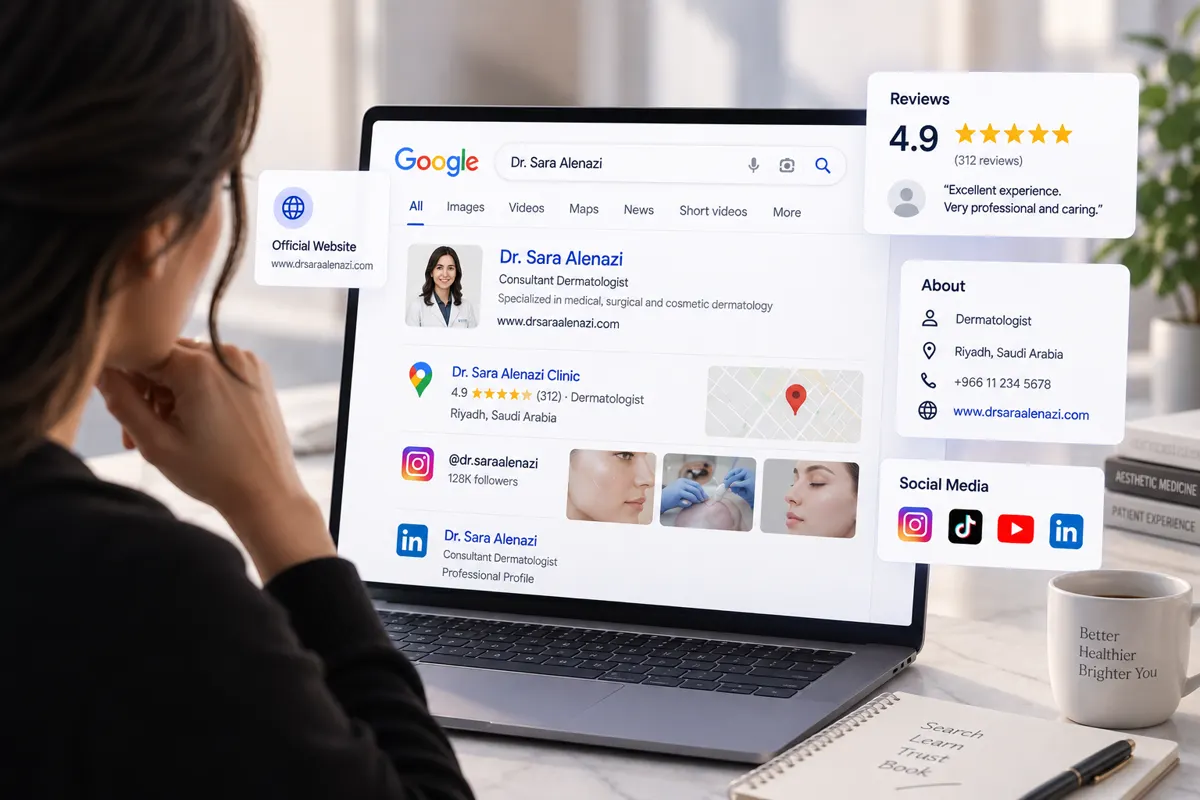
What Does a Patient Find When They Search Your Name on Google?
Before booking, a patient types the doctor’s name on Google. What do they see? How does the professional picture form from results, website, reviews, and social media?

How Long Does It Take a Doctor to Show Up on Google? Realistic Expectations for the First Months
Showing up on Google isn’t one moment: your name, then Maps, then searches for your specialty. When to expect each, what speeds it up, and how to track progress yourself.