
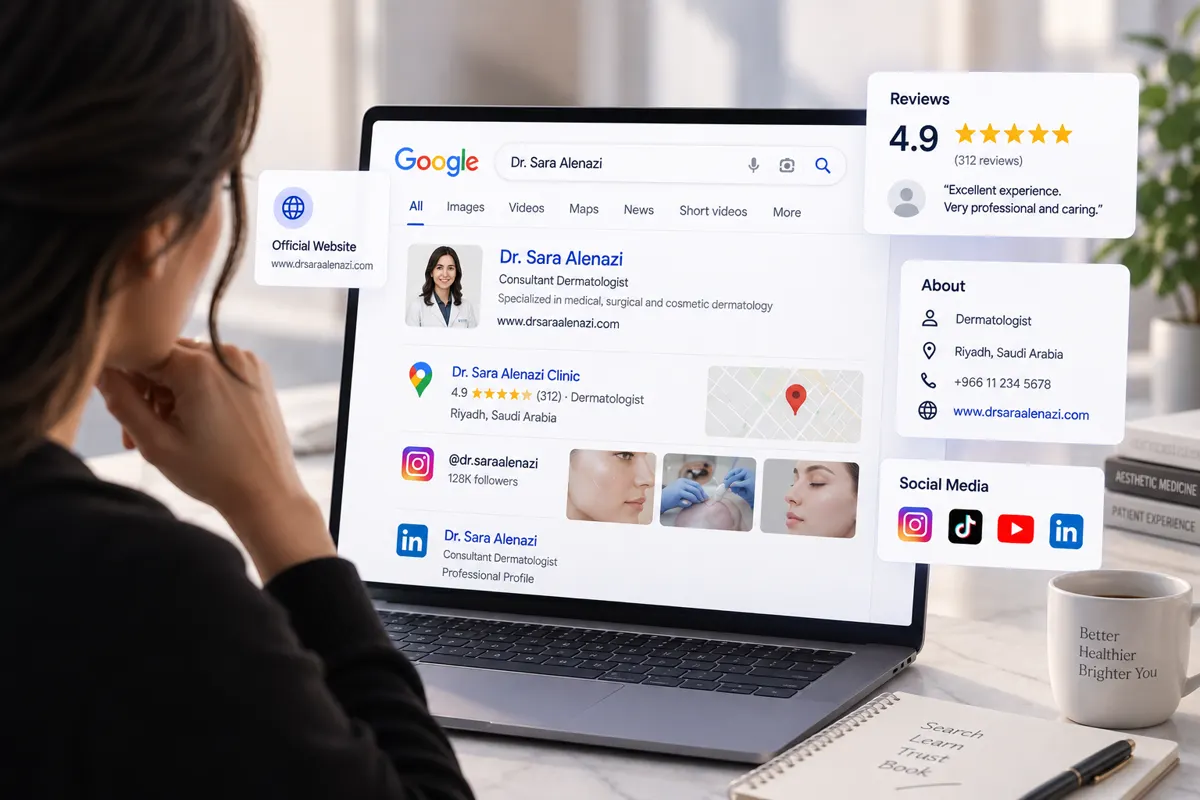
A patient may hear about a doctor from someone they trust, see their content on a social platform, or get the name from another doctor. But before reaching out or booking, there is a simple step they may take:
They type the doctor’s name on Google.
In that moment, the patient is not only looking up a name. They are trying to understand: Who is this doctor? What is their specialty? Where do they work? What is their experience? What can be found about them? And does the information in front of them give a clear, trustworthy picture?
That is why a doctor’s appearance on Google has become an important part of their presence and digital reputation.
The problem is that professional expertise does not transfer to the internet automatically. A doctor may have many years of experience, while search results paint a limited or scattered picture that does not reflect their real professional standing.
What does the patient see when they search the doctor’s name?
Search results differ from one doctor to another, but they may gather information from multiple sources, such as:
- The doctor’s website.
- The doctor’s page on a hospital or clinic site.
- Google Business Profile and Google Maps when a suitable profile exists.
- Professional accounts on social platforms.
- Medical booking sites and platforms.
- Ratings and reviews.
- Articles and content published under the doctor’s name.
- Research or academic and professional pages.
- Media appearances and conferences.
- Photos and videos linked to their name.
Each of these results forms a small part of the picture.
So the question is not only:
Does the doctor’s name appear on Google?
It is:
What picture of the doctor is formed from the results that appear?
Appearing on Google does not necessarily mean a strong digital presence
Having several results under the doctor’s name does not automatically mean a strong digital presence.
The doctor’s name may already appear, yet the patient finds:
A specialty written differently from one platform to another, outdated information, inactive accounts, a brief hospital page, contact numbers no longer in use, or results that do not clarify their area of expertise enough.
In that case the doctor is present digitally, but not clear digitally.
By contrast, results may be fewer but consistent, and quickly help the patient know the doctor, specialty, experience, and how to reach them.
That is the difference between merely existing online and building a doctor’s digital presence.
First test: search your name as a patient, not as a doctor
One of the simplest ways to understand your current situation is to search your full name on Google.
If you use your name professionally in Arabic and English, try both forms.
Then look at the page as if you know nothing about the person in front of you.
Ask:
Is the doctor’s specialty clear?
Do I find up-to-date information about them?
Do I find their official website or a clear source for their information?
Do I know where they work?
Do I find content that reflects their area of expertise?
Are the accounts that appear official and active?
Are there reviews or information that help me form a picture of them?
Can I tell how to contact or book?
These questions matter more than simply asking: Where do I rank on Google?
Does Google understand who you are and your specialty?
This is a core point in building a doctor’s visibility.
Google does not necessarily rely on a single page to understand the doctor. Information across the website, professional pages, content, medical entities, accounts, and other platforms can together shape a digital picture of them.
That is why information consistency matters.
If the name appears in many different forms, the specialty is described differently, work details are outdated, and sources do not offer a clear picture, the doctor’s digital footprint becomes more scattered.
When clear, consistent professional information repeats across trusted sources, it becomes easier for the user — and for search engines — to understand the link between the doctor’s name and their field of work.
The goal here is not repeating keywords everywhere, but building a clear digital professional identity.
What if the doctor works in a well-known hospital or clinic?
Working in a well-known hospital or medical center matters, and the doctor’s page on the facility’s website may be among the main results when someone searches for them.
But there is a difference between:
The presence of the facility where the doctor works
and
The doctor’s own independent digital presence.
The doctor may move to another facility, work in more than one clinic, develop a specific specialty focus, or see their career path change over time.
So having digital assets tied to the doctor’s own name helps build a professional presence that travels with them, instead of relying entirely on the digital platform of the organization they work for.
That does not mean replacing the hospital’s presence, but forming a digital picture that complements it.
The website: a clear source about the doctor
When someone searches for a doctor, it helps to find a place where they can get clear, complete information about them.
That is where the value of a doctor’s website shows.
A website can gather in one place:
- An introduction to the doctor.
- Their specialty and experience.
- Professional qualifications.
- Areas and procedures they work on.
- Medical content related to their specialty.
- Work locations when needed.
- Contact or booking paths.
It also gives the doctor a digital space that does not depend entirely on a social platform’s algorithm or design.
But creating the website alone is not the goal. Its real value appears when it is clear to the user, organized for search engines, and connected to the rest of the doctor’s digital presence.
What do Google reviews tell the patient about the doctor?
After learning the doctor’s specialty and experience, the patient may look for others’ experiences.
That is why reviews are part of a doctor’s digital reputation.
The patient does not always look only at the star count. They may read comments and try to form an impression of communication, service, organization, and manner.
How public reviews are handled also shapes the professional picture.
In healthcare specifically, replies must be handled carefully, with respect for patient privacy, without revealing or confirming private health information in a public space.
The goal is not a page that looks perfect, but a professional, genuine digital reputation that is managed continuously.
What about social media?
Social platforms can be an important part of the results through which a patient discovers the doctor.
But social media does not mean only Instagram and TikTok.
There are Instagram, TikTok, YouTube, LinkedIn, Facebook, and other platforms, each with a different audience and way of use.
The most important question for the doctor is not:
On how many platforms should I be present?
It is:
Which platforms best fit my specialty, audience, and the goal of my digital presence?
One platform may suit a doctor who wants to reach patients with short visual content, while another is more useful for a doctor who relies on deeper educational content or wants to build relationships and standing inside their medical community.
So the requirement is not that the doctor open an account on every platform.
It is better to be present strongly and consistently on the platforms that fit them, rather than weakly and scattered everywhere.
And when those accounts appear on Google, they should complete the same professional picture the patient finds on the website and other sources.
How do you choose between Instagram, TikTok and LinkedIn? See Social media for doctors: Instagram, TikTok or LinkedIn?.
Does follower count affect the picture the patient forms?
Follower count may be one thing the user notices, but alone it does not equal reputation or the strength of digital presence.
A doctor may have a large audience, yet when searched their professional information is scattered, their website is weak, or their specialty is unclear.
Another doctor may have a much smaller audience, while the patient finds a strong website, clear professional information, specialized content, and a good rating.
So follower count is a social signal, not a full measure of a doctor’s digital presence strength.
Does the content a doctor publishes affect search results about them?
Content is an important part of a doctor’s digital footprint.
When a doctor publishes specialized content around questions and topics tied to their field, they not only help their audience understand those topics — they also build a knowledge library linked to their name and expertise.
There is real value in content that lives beyond short posts alone.
Service pages, articles, educational videos, and long-lived professional content can keep delivering value long after publication.
That is why we treat content as a digital asset that accumulates over time, not merely a weekly posting schedule.
What happens when information differs from one platform to another?
This problem looks small, but it matters.
The patient may find one specialty on the website, a different description on a social account, a former workplace on another page, and an old phone number in a fourth result.
The result is friction.
The user starts asking:
Which information is correct?
Is this account official?
Does the doctor still work here?
How do I contact them?
The more effort the patient needs to verify information, the more complicated their journey becomes.
So consistency of the doctor’s name, specialty, professional details, and contact paths across their digital presence is a core element of building a clear picture.
Why can your expertise be strong while your Google visibility is weak?
Because Google does not see years of experience the way colleagues or patients know them.
A doctor may be very well known inside their field, yet still lack enough digital sources that reflect that standing.
Here two things must be separated:
Real professional expertise
and
How well the internet can discover and understand that expertise.
Building digital presence is not about creating a picture larger than the truth.
On the contrary.
The goal is for the picture online to reflect the expertise that already exists in real life.
Searching by the doctor’s name and searching for a doctor in a specialty are different
This is a very important point in SEO for doctors.
There is a difference between someone who types:
"Dr. Ahmed Mohammed"
and someone who types:
"dermatologist in Jeddah"
The first already knows the doctor. They may be in a verification stage before booking.
The second is still in discovery and comparison.
That means building a doctor’s appearance on Google has more than one level.
We want the person to find the doctor when they search by name, but over the long term it may also matter to build presence around their specialty and related topics and services.
So a doctor’s appearance on Google is not limited to ranking their name alone. For those who want to build strong organic visibility, see our SEO for doctors.
What should the patient find in the first minute?
When someone searches the doctor’s name, they should not need a long research journey to understand the basics.
In a short time, they should be able to answer questions such as:
Who is the doctor?
What is their specialty?
What is their area of expertise?
Where do they work?
Is the information I find about them current and consistent?
Where can I find more information?
How do I contact or book?
The clearer the answers, the better the search experience.
Google is part of the patient journey, not just a search engine
The patient journey can start in more than one place.
They may hear the doctor’s name from someone.
Then search for them on Google.
Then enter the website.
After that read reviews.
Then watch the doctor’s content on the social platform that fits them best.
Then return to the website or a contact channel.
Then book.
So the journey may look like this:
Recommendation or discovery → Google → verifying the doctor → website, content, and reviews → trust → contact → booking
That is why it is a mistake to treat the website, Google, social media, and reviews as separate pieces.
For the patient, they are all parts of one experience.
What about a doctor’s appearance in ChatGPT and AI search engines?
The way people search itself has started to change.
Users no longer rely only on typing words into Google and opening a set of links. They can ask a full question to AI-powered search tools and get a direct answer.
That does not mean there is a quick or guaranteed way to make an AI tool recommend a specific doctor.
But the shift raises the importance of something fundamental:
That information about the doctor online is clear, organized, consistent, and tied to trusted sources.
The website, content, professional pages, reviews, and presence across different platforms together form the doctor’s digital footprint.
As search evolves, the quality of that footprint becomes more important, not less.
Try searching for yourself today
Type your name on Google in Arabic.
Then type it in English if you use the name in both languages.
Also try the name with your specialty.
Then view the results on a phone, because that is how many patients will see your presence.
And do not only ask:
Did I appear?
Ask:
Does the picture I found actually reflect the doctor I am today?
If the answer is no, the problem may not be that you need more content or more followers.
The problem may be that the pieces that already exist do not work together as one clear digital presence.
Your name is known professionally — does the internet know it the same way?
A doctor may spend years building expertise and reputation, while a Google page needs only seconds to form a first impression for someone searching them.
That is why this picture should not be left to chance.
A doctor’s appearance on Google is not merely a ranking issue in search results. It is part of their identity, reputation, and the patient’s digital journey before booking.
At PRESLUME we see a doctor’s presence as a connected system that includes professional identity, Google visibility, the website, content, the social platforms that fit them, and digital reputation — so expertise becomes easier to discover, understand, and trust.
The question is not only: Does the patient find you on Google? It is what they understand about you when they find you.
Frequently asked questions about a doctor’s appearance on Google
Why doesn’t the doctor’s name appear clearly on Google?
Reasons differ from case to case. Published information may be limited, existing sources disorganized, pages poorly prepared for search, or similar names may exist. Current search results should be assessed before defining the problem.
Does a doctor need a website to appear on Google?
A doctor can appear through multiple sources without a personal website, but a website gives an independent source to organize professional information and content and build presence over the long term.
What is the best social media platform for a doctor?
There is no single best platform for every doctor. The choice depends on specialty, audience, market, content type, and goal. Some doctors benefit more from Instagram or TikTok, while YouTube or LinkedIn may be more valuable for other goals. The best platform is the one that serves the doctor’s strategy, not only the most famous one.
Are Google reviews important for a doctor’s visibility?
Reviews matter especially for digital reputation and the patient experience, and can relate to local presence when the doctor or facility has an eligible Google profile. But search visibility depends on multiple factors, not reviews alone.
Does a large follower count make a doctor appear better on Google?
Not necessarily. Follower count does not make up for a weak website, inconsistent information, or unclear search presence. Social media is part of the system, not the whole system.
How do I know if my Google presence is good?
Start with what the user sees: search your name in different forms, then assess specialty clarity, information accuracy, sources that appear, reviews, official accounts, the website, and how easy you are to reach.
Related articles
How Do Patients Search for Doctors on Google? And What Makes You Show Up Clearly
From the first word a patient types in Google to the moment they choose a doctor — understand how patients read search results and what makes your name appear clearly when they look for you.
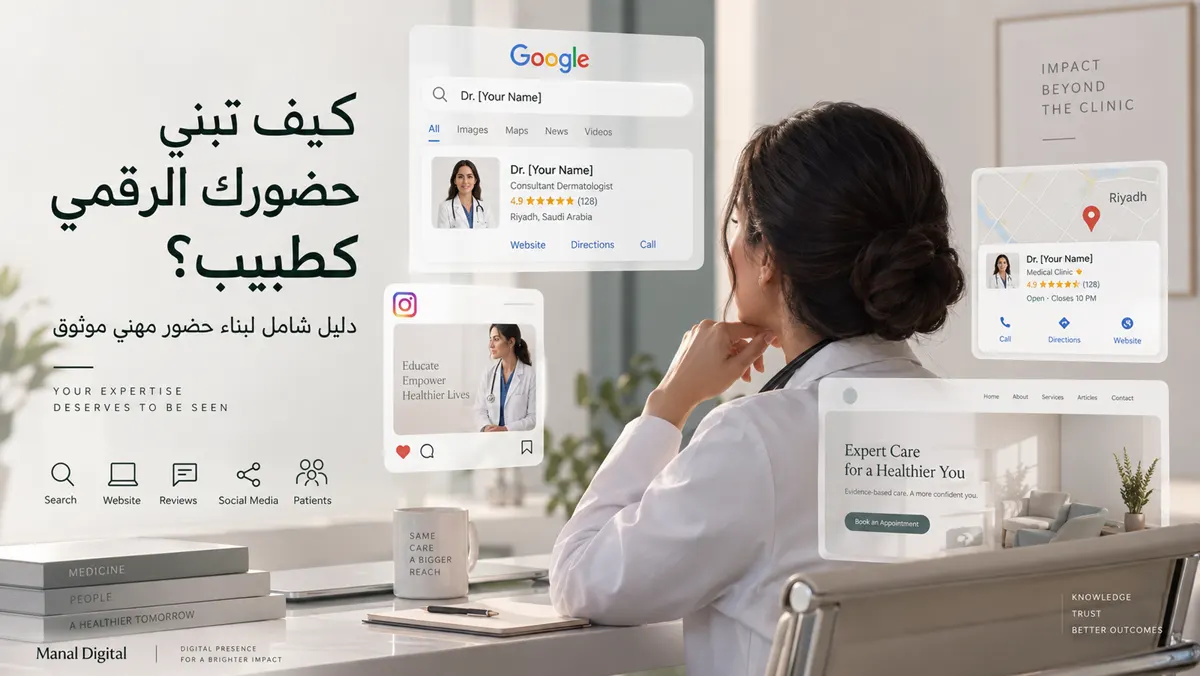
How Do You Build Your Digital Presence as a Doctor? A Complete Guide to a Trusted Professional Presence
A complete guide to building a trusted professional presence: from Google results, website, and reviews to content, the patient journey, and AI search readiness.

How Long Does It Take a Doctor to Show Up on Google? Realistic Expectations for the First Months
Showing up on Google isn’t one moment: your name, then Maps, then searches for your specialty. When to expect each, what speeds it up, and how to track progress yourself.